<< Intro – 3 - - Introduction – 4:6 - - Intro – 5 >>
The West vs. Eastern Europe: Comparative Excess Mortality Curves
5G Network Demand-Based Management
As commercial 5G cell phones and other products become available to end users, the need to utilize the services and capabilities of the 5G system also increases. The period from March to May 2020 therefore marked the true starting point for public 5G networks; prior to that, the 5G systems that had been built were not used to any significant extent other than for experimental purposes or in preparation for future use. Consequently, these systems have not undergone extensive and complex startup and configuration phases compared to other radio-based XG bands, RF bands, and base stations—that is, system adaptation to accommodate the expected and growing number of customers actively using the various mobile networks [2G, 3G, 4G, 5G], etc.
Commissioning processes and stress tests are important for mitigating interference issues with other microwave-based RF technologies and systems (cellular networks, smart technology, Bluetooth, radar, military and law enforcement applications, etc.) and for enabling cellular network providers to deliver a seamless, fast, and reliable cellular network to end users.
Correlating 4G/5G Deployment Patterns and Mortality Trends
With the launch of 5G systems [starting in March 2020], a pattern of increased mortality emerged that persists to this day in a very large number of countries around the world, with high mortality peaks associated with major 4G+/5G development phases of mobile networks, changes such as 2G/3G refarming, or the introduction of 5G Stand Alone (5G-SA), mm-wave frequencies, new antenna types, etc.
Enlarge Image: Click on the image – (opens in new window)
Western Countries vs. Eastern Europe, Comparison Chart |
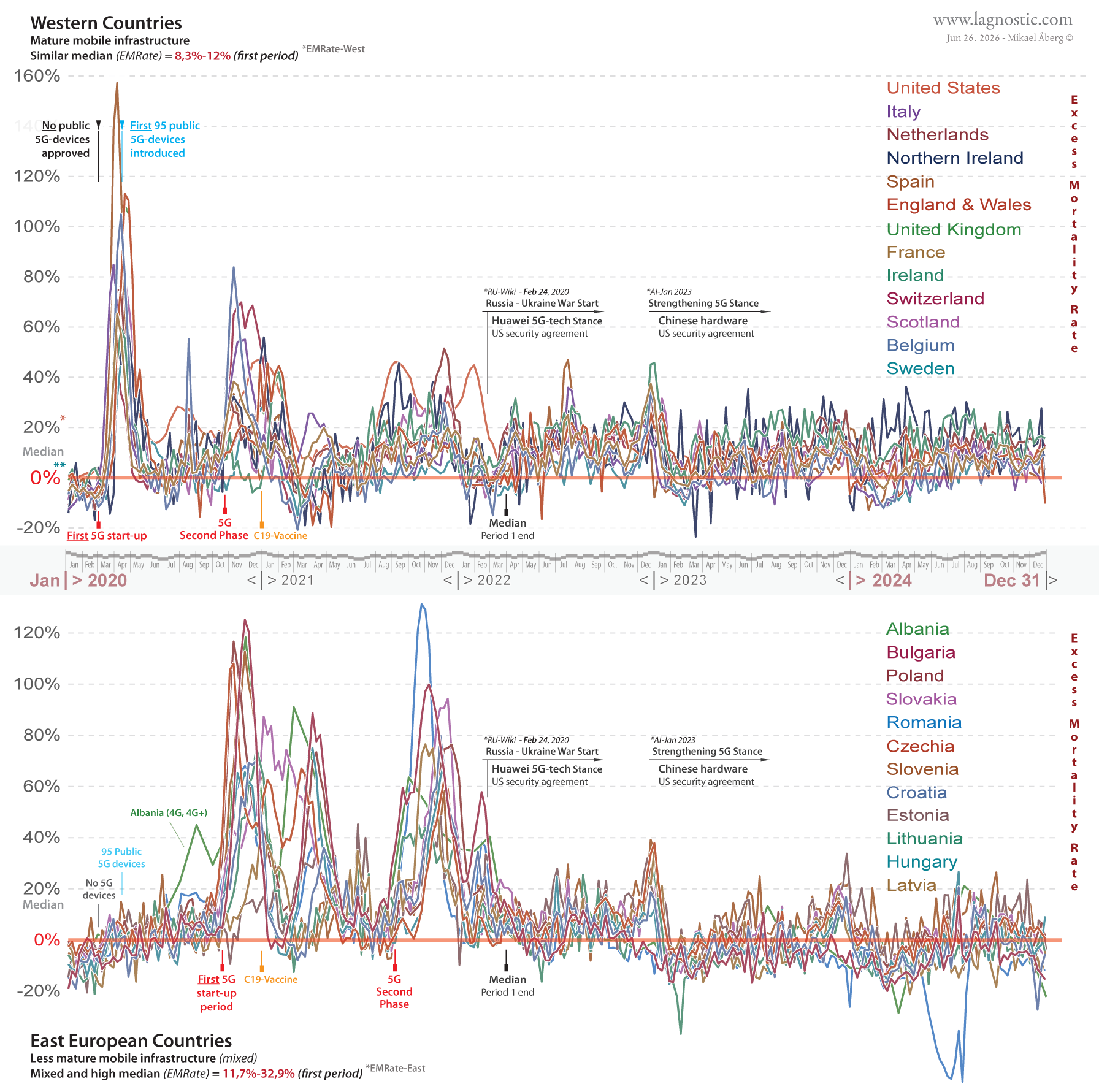 |
EMRate curves for 25 different countries [Year 2020-2024] |
Correlated Patterns
Clear patterns have emerged during the analysis of the collected research data; local mortality rates are strongly linked to the startup phases and updates [during commissioning and stress tests] of area-specific 5G systems, resulting in very high local mortality rates.
The point is that the launch and rollout of mobile networks begin before the technology is presented to customers; without an understanding of this fact, it may seem extremely strange that mobile technology could be implicated in the extreme excess mortality the Western world experienced in March–April 2020, when, in practice, there were very few, if any, paying users of 5G services or 5G cell phones.
In other words, cell towers and antenna arrays are deeply involved [quantum mechanically] in human anatomical functions and development—bodily processes that are primarily governed by polar [dipole] interactions and systems. Radiofrequency (RF) radiation creates a new reality in the form of extremely large changes to our natural and vital electromagnetic (EM) background radiation, which has shaped life on Earth, its conditions, and its future since time immemorial.
Initial Phase – Densely Populated/High-Traffic Areas
The very high mortality rates in Western countries and the rollout phases of 5G systems in March–April 2020 are linked to similar areas—that is, densely populated or heavily visited areas—which strongly influence countries’ Excess Mortality Rates (EMR). The same applies to the expansion in Eastern Europe, which began several months later [October 2020], due to a less developed XG infrastructure.
The temporal correlation between the rollout and upgrade phases of 4G+/5G systems and excess mortality rates in all countries is very strong, with clearly altered mortality patterns linked to the expansion and upgrade of mobile networks [2G/3G refarming, 5G Stand Alone, Massive MIMO antennas…] or changes of a different nature [the U.S. Security Agreement, the Russia-Ukraine war, the 5G moratorium, etc.].
Note. The majority of so-called “well-developed” 5G countries are facing increasing problems with mental health issues, chronic disease, and low/declining birth rates, with EMRate values [excess mortality] that are consistently higher than they are today, despite previously [as of March 2020] very high mortality rates and generally good access to advanced healthcare and social welfare systems—an extremely contradictory fact that in itself suggests some form of recently emerged environmental stressor, one that affects both life and health.